
Pioneer Park Design Update
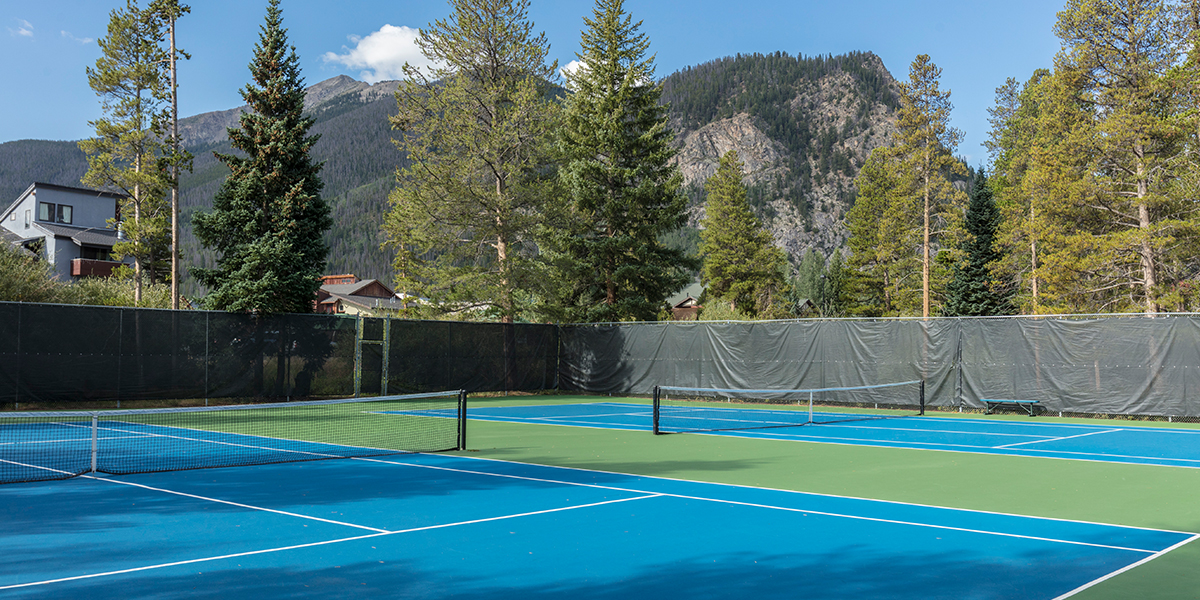
Pioneer Park is located at the intersection of 6th Avenue and Galena Street and currently includes two public tennis courts but lacks other amenities such as restrooms, play features, signage, or more formal pathways. The purpose of the January 27 Town Council work session was to provide direction to staff and SCJ Alliance regarding how to move forward into a final design for Pioneer Park. During the January 13 meeting, Council heard a presentation and public comment, discussed the proposed park design options, and decided to continue the discussion on January 27 to allow for more time to research, speak with the public, and further consider the results of the community engagement efforts.
Background
In 2024, the Town of Frisco was awarded a Department of Local Affairs (“DOLA”) Strong Communities Grant to support infrastructure for the 54-unit, workforce housing project located at 602 Galena Street. A portion of this funding was allocated to Pioneer Park improvements, as Pioneer Park is close to this new housing development, and with these 54 new units of housing being completed in 2026, the demands on and uses of Pioneer Park are expected to change.
In 2019, the Town Council adopted the Neighborhood Parks Master Plan to guide future investment in parks, open space, and recreational facilities. The plan identified a need to revitalize Pioneer Park and proposed a conceptual vision for improvements. Community feedback gathered as part of the 2019 Neighborhood Parks Master Plan process identified the following existing concerns with Pioneer Park:
- Lack of public visibility and signage
- Unclear status of tennis courts (public vs. private perception)
- General lack of maintenance and defined purpose
Feedback from the 2019 Neighborhood Parks Master Plan was considered as a starting point for the design in 2025. However, master plans are typically updated every 5-10 years and given the evolving needs of the community and the new workforce housing development at 602 Galena Street, a new community engagement process was needed to update the findings from 2019.
In August 2025, Council approved a contract with SCJ Alliance for the design of Pioneer Park. As stated in the August 2025 memo to Town Council, the primary goal of the project is to improve and revitalize Pioneer Park to better serve the entire community through additional uses, features for a variety of ages, restrooms, and improved connectivity to Town. Other goals include:
- Serve residents at 602 Galena Street and other neighborhoods within the downtown core
- Improve drainage, infrastructure, and parking
- Add signage and wayfinding to connect to Main Street and beyond
- Provide educational/interpretive features
- Provide play features for children
- Evaluate a basketball court or sport court addition to the park
- Add restrooms
- Maintain and protect the existing wetlands
- Maintain and enhance the natural environment of the park
- Define winter uses and evaluate snow storage options for the site
- Evaluate tennis court usage and provide recommendations for future considerations
Pioneer Park Agenda Topics for January 27 Meeting
At the January 27 work session, Council was asked to:
- Listen to a brief presentation summarizing the discussion from the January 13 Council meeting and additional information gathered in response to that meeting.
- Establish direction for a final design of Pioneer Park, utilizing the provided Direction Matrix and two conceptual plans to provide feedback on:
- Court configuration: Two tennis courts or one tennis and one multi-use court
- Recreation focus: Tennis and passive/nature focus or broader active recreation
- Parking approach: On-street (6th Avenue) or internal/adjacent to the courts
- Level of wetland disturbance: Minimize disturbance or allow boardwalk connections through wetlands
- Neighborhood sensitivity: Quieter or more activity
Council Discussion and Direction
In order to take the Pioneer Park project out to bid for construction this summer, Council gave the following direction to the design team:
- Keep the two tennis courts with a basketball hoop on one of the tennis courts to create a half court. This will necessitate a tall fence between the two tennis courts.
- Build a parking area adjacent to 6th Avenue and use the park for recreational use, not parking.
- Create sound mitigating landscaping to the west- between the park and adjacent to residential properties.
- Council would like the park to be usable in the winter, and the consultant team said that this might be partially achievable by leaving the courts accessible for play, snowman building, etc…
- Have limited to moderate disturbance of the wetlands with some boardwalks through that area.
- Install educational signage in the park and along the boardwalk.
- Preserve the large trees and landscaping as much as possible and include habitat for small wildlife, like birds.
- Install dispersed play areas or nodes that are unique and fit the natural environment and which will not duplicate what is at Walter Bryon Park- no traditional playground equipment. Council suggested looking at features like permanent chess tables, boulders, and other more natural play features.
- Make the seating area softer and move away from a cement pad and into more natural materials.
Water Rate Discussion
Background
In May 2025, the Town of Frisco contracted Raftelis Financial Consultants, Inc. to complete a comprehensive Water Rate and Connection Fee Study. The last full water study for the Town of Frisco was adopted in 2019 and established new rates and a tiered structure through October 2024, which increased water rates by 5% annually. To bridge the gap from October 2024 until the new study was completed, water rates continued to increase 5% per year.
Current Conditions
- 34 miles of water mains – roughly the distance between Frisco and Avon
- 4,700 water customers: 2,155 active water accounts holding 4,668 Equivalent Residential Unit (EQR’s)
- 350 fire hydrants
- Three (3) storage tanks
- $30 million estimated replacement value of water infrastructure (excluding water rights)
- One (1) million gallons per day (MGD) delivered from three (3) wells and a surface water treatment plant – enough to fill 2.5 football fields, one foot deep, daily
- Water utility owns and maintains all water mains, hydrants and main line valves
- Water customers own and maintain all service lines and curbstop valves from the tap at the water main to the interior of the building
Frisco’s Current Water Rate Structure
Customers pay a quarterly base rate of $57.43 per EQR, plus tiered usage charges designed to promote conservation.
Tier Water Use (per EQR) Rate per 1,000 Gallons
- Tier 1 1–8,000 gallons $1.44
- Tier 2 8,001–16,000 gallons $2.86
- Tier 3 16,001–50,000 gallons $5.10
- Tier 4 Over 50,000 gallons $6.38
Future Water Projects
The 10-year maintenance and improvement plan for the Frisco water system includes $29,916,429 in anticipated improvement and maintenance needs. This includes well and water tank maintenance and rehab, hydrant replacements, water main replacements, a new well, new treatment equipment, and general water division equipment needs, such as vehicles.
Previous Council Direction
At the December 9, 2025 Council work session, staff and Raftelis presented a Peer Utility Comparison benchmarking Frisco’s rates against comparable mountain communities. Staff and Raftelis also reviewed two potential rate structure alternatives designed to achieve the planned 8.5% annual increases from 2026 through 2029. At that meeting, Town Council directed staff to advance a scenario that adjusts rate components to better reflect underlying system cost drivers. Under the Council-directed scenario, the service charge remains consistent with the current base rate. Residential and commercial/mixed-use accounts would use the same four-tier structure, with Tier 3 reduced from 50,000 to 35,000 gallons and the Tier 3-to-Tier 4 pricing ratio increased to more clearly differentiate moderate and high water use. Irrigation would be billed at a uniform rate.
Tap Fee Analysis
Tap fees are one-time charges assessed on new development to recover the cost of utility system capacity required to serve additional demand. The fee reflects both the value of existing and planned capacity and the amount of capacity reserved for new connections, including facilities such as treatment, transmission mains, and storage.
Tap fees are subject to statutory requirements under Colorado Revised Statutes § 20-20-104.5, which requires local governments to establish fees at a level no greater than necessary to defray the impacts of development. Based on its analysis, Raftelis recommended a revised tap fee of $10,475, an increase from the current $7,320.50. This recommended amount is derived from an estimated $8,080 for infrastructure-related capacity and $2,395 associated with the water resource. This fee structure is in alignment with and builds upon the Town’s out-of-district fee valuation adopted in 2022 for water requests from outside the Town of Frisco’s boundaries.
Council Discussion and Direction
The January 27 work session presentation built on previous discussions by focusing on updates to tap fees to finalize the overall water rate package, as well as reviewing the public communication plan.
- Council gave direction to move forward with raising the tap fee to $10,475, bringing Frisco’s tap fees to the middle in comparison to neighboring communities.
- Council gave direction to move forward with the plan presented for communicating the water rate changes.
Discussion of 2024 International Building Code Council Code Adoptions
The purpose of this work session was to familiarize the Council with the series of updated building codes proposed for a first reading during the March 24, 2026 Town Council meeting; to be noted that international building code updates are only updated every three years, and the Town of Frisco typically adopts a new series of building codes once every six years. The Town is currently using the 2018 versions of the International Code Council (ICC) codes.
The Town’s contracted building inspection consultant group, Comprehensive Building Code Services (“CBCS”), presented these proposed updates, along with the feedback received at the January 14 Board of Appeals meeting. Summit Fire will be attending the February 10, 2026 Council meeting to discuss their proposed amendments to the 2024 Fire Code, so any discussion of fire code were held until then.
Council Discussion and Direction
Council recommended moving forward with minimal amendments to increase the requirements for construction in Frisco, due to the desire to balance cost with progress and sustainable building efforts.
Frisco’s Finest Proclamation for Cindy and Wayne Spaulding
Town Council presented Cindy and Wayne Spaulding, Frisco community members and founders of the Boatyard/Uptown on Main, with a proclamation declaring them Frisco’s Finest to acknowledge their significant contributions to Frisco. Cindy and Wayne have been pivotal in creating a thriving restaurant community in Frisco, as well as always showing up for the Frisco community with their exceptional generosity.
Lighting/DarkSky Ordinance
During the January 27, 2026, staff presented an ordinance for proposed modifications to Chapter 180 of the Code of Ordinances of the Town of Frisco regarding outdoor lighting, and staff reiterated that there would be 10 years to comply with the changes if adopted. Specifically, changes are in response to Town Council direction to pursue certification as an International DarkSky Community and community feedback for more responsible lighting practices.
Significant changes proposed to the existing lighting regulations:
- A maximum correlated color temperature (CCT) of 3000 Kelvin.
- Defined curfew hours for public lighting, seasonal lighting, festoon lighting, outdoor recreation lighting, and illuminated signage. All properties are to comply with curfew hours within one (1) year of adopting the ordinance.
- Limits on total illumination allowed on a property (measured in lumens).
- Clear requirements for motion-sensor security lighting.
- Limits on luminance levels for signage illumination.
- Compliance for all fixtures within 10 years of adopting the ordinance.
Other proposed code amendments include:
- Pole lights limited to 12-20 feet in height depending on residential use, parking areas adjacent to residential use, or non-residential use.
- Exemptions for historic fixtures that are consistent with the historic character of a structure in the Historic Overlay District.
- Adaptive controls (motion sensors, dimmers, timers, etc.) for all publicly owned lighting, including streetlights, public facilities, park lighting, and outdoor recreation/athletic field lighting.
- Exemptions for seasonal lighting (allowed for part of the year) and festoon lighting (allowed year-round for specific uses), with a curfew and other limits.
- Changes to the submittal process and requirements to comply with the proposed requirements.
Council Discussion and Decision
Council decided not to add regulations to the ordinance around fixtures that have glass extending below a fully-shielded bulb, as DarkSky International Council confirmed that these fixtures meet DarkSky standards as the bulbs are fully shielded. Subsequently, Council passed Ordinance 26-03 on first reading. The second reading will be on February 10, 2026.