
Dark Sky & Outdoor Lighting
International Dark Sky Community Certification
The Town of Frisco is a certified International Dark Sky Community through DarkSky International. DarkSky International is a global nonprofit dedicated to protecting the night environment and reducing light pollution through education, advocacy, research, and responsible outdoor lighting.

The International Dark Sky Community certification recognizes communities that protect dark skies through strong lighting policies, public education, community support, night sky monitoring, and long-term stewardship. Certified communities commit to reducing glare, light trespass, and skyglow while maintaining safe and appropriate outdoor lighting for residents, visitors, wildlife, and future generations.
This effort supports Frisco’s mountain character, protects views of the night sky, reduces light pollution, and benefits wildlife, residents, and visitors. This commitment will also involve updating all lights (public and private) in the Town by 2036 to meet the requirements in Town Code – see the FAQs below for more information.
As part of the certification process, the Town has:
- Adopted updated outdoor lighting regulations that meet DarkSky International requirements, including standards for fully shielded fixtures, warm-colored lighting, lighting curfews, and limits on unnecessary light.
- Completed a Town-owned lighting inventory to identify which public fixtures are already compliant and where upgrades are needed.
- Updated key public lighting, including Main Street streetlights, with fully shielded fixtures and controls that reduce light levels later at night.
- Hosted community education events, including Frisco Elementary STEM Day, a bird migration and light pollution presentation, outreach tables at Town events, solar viewing, stargazing, and constellation programs.
- Installed new educational signs in Town parks with information about Frisco’s night sky, wildlife, cultural history, and seasonal stargazing.
- Established ongoing sky brightness monitoring, including quarterly measurements at locations across town and continuous monitoring near 1st and Main Street.
- Prepared a full application for certification as an International Dark Sky Community.
Frisco will continue public education, lighting improvements, and night sky monitoring as part of its long-term commitment to protecting dark skies.
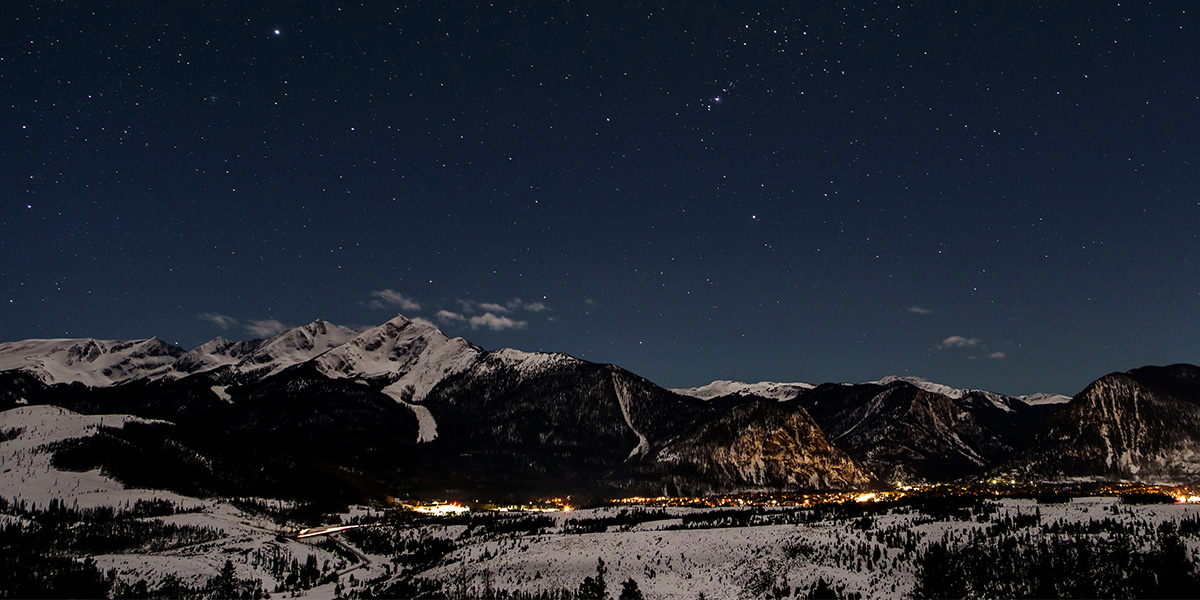
Frisco continuously monitors sky brightness near First Avenue and Main Street. Higher Sky Quality Meter (SQM) readings mean a darker sky. Moonlight, clouds, snow, weather, and nearby lighting can all affect the measurements.
Explore the Night Sky
Use the slider to travel through Frisco’s nightly record. The solid line shows Frisco’s sky darkness on the left axis; the dashed line shows estimated birds in flight over Summit County on the right axis. Shading shows when the moon was above the horizon.
How the Moon Changes the Night Sky
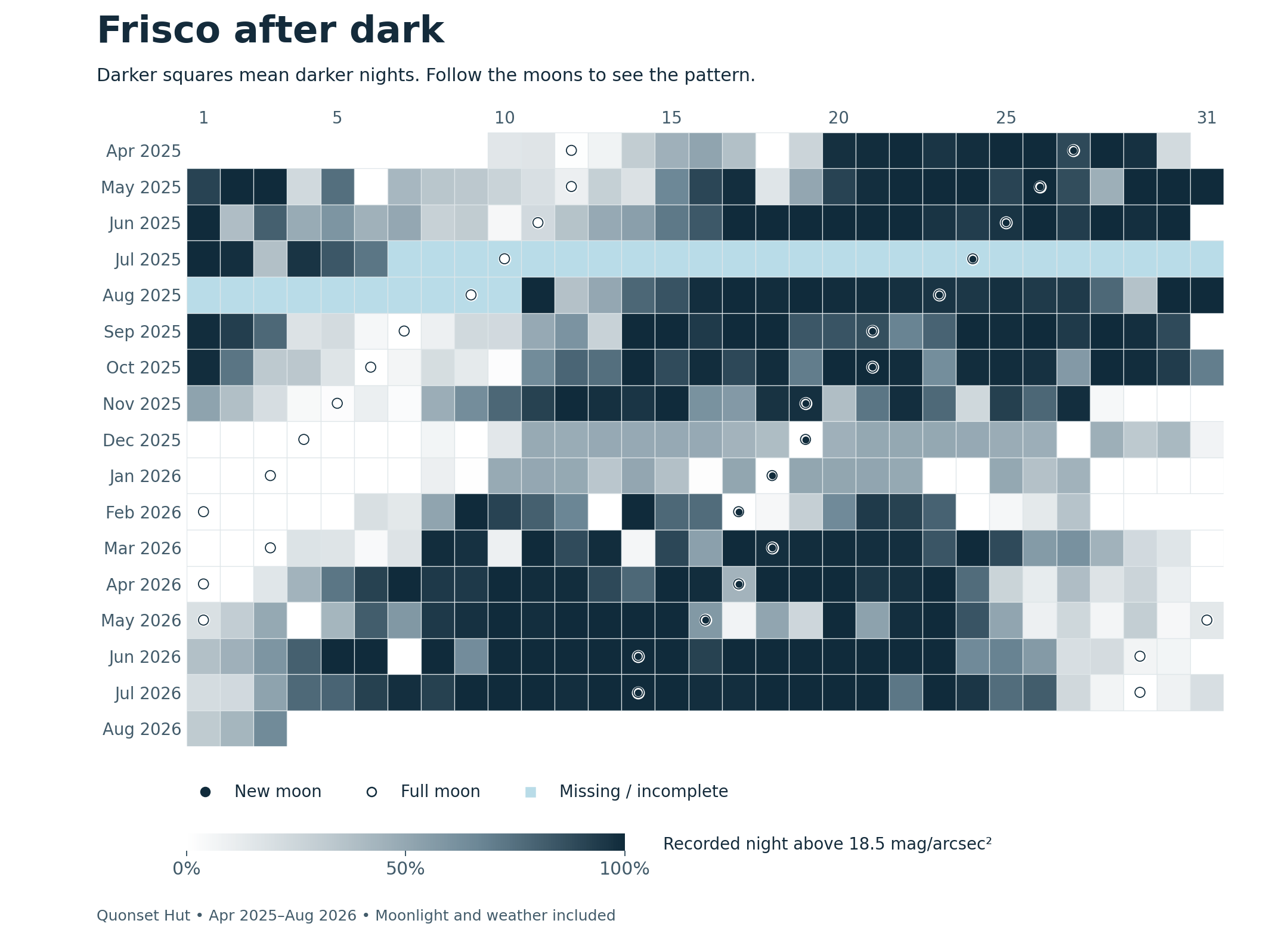
The moon creates one of the clearest repeating patterns in Frisco’s sky measurements. Nights around the new moon are generally darker, while a bright full moon can lower the measured darkness even when outdoor lighting has not changed.
Seasonal Lighting and Winter Nights
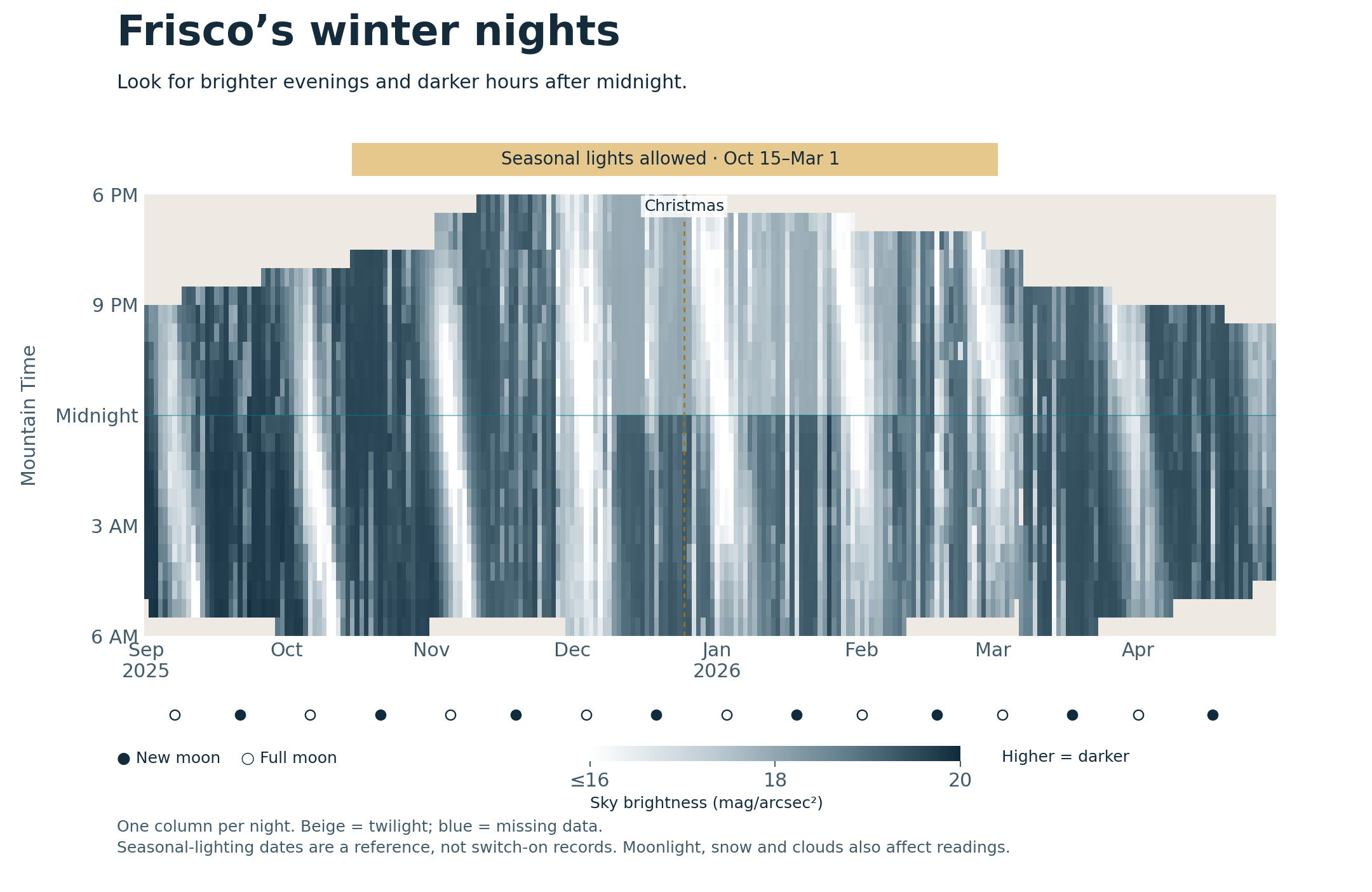
Seasonal lights are allowed in Frisco from October 15 through March 1. Beginning March 1, 2027, residential seasonal lights must be turned off from 10:00pm to 7:00am. Businesses operating during those hours must turn them off from one hour after closing until one hour before opening.
The graphic below shows how measured sky darkness changed through winter evenings and overnight hours. It provides context for exploring seasonal patterns; it does not prove that seasonal lighting caused any individual change. Moonlight, clouds, snow, and missing readings also influence the pattern.
Dark Sky Events
Check out fun and educational events put on throughout the year by the Frisco Historic Park & Museum, including the Park After Dark series.
Outdoor Lighting FAQs
- When do I need to comply with the lighting rules?
- All privately owned lights must be in compliance with the new code by March 1, 2036.
- Curfews for festoon lights, seasonal lights, and business signage go into effect on March 1, 2027.
- Property owners doing projects that require a planning application will be required to bring their lighting into compliance at the time of the project.
- When do my seasonal lights need to be in compliance?
- Seasonal lights are allowed from October 15 to March 1. Any seasonal lights should be turned off or removed for the summer, until October 15.
- From October 15 – March 1, lights must be turned off from 10:00pm-7:00am for residential units. For businesses with operating hours during that time, lights must be turned off from one hour after closing until one hour before opening. Multi-colored lighting is allowed.
- Is there any “grandfathering” of light fixtures or properties?
- No – All light fixtures must be in compliance by March 1, 2036.
- Can I reuse my existing light fixtures?
- Yes – You can modify some styles of light fixtures to be compliant with the new code. Retrofits may include replacing a light bulb with one that is less bright (lower lumens) and/or 3000 Kelvins, depending on what is needed. Or, retrofitting might include adding a permanent, opaque material that extends to the lowest portion of the light bulb in order to make the light fixture fully shielded.
- Check out resources on retrofitting from the Town of Breckenridge.
- Please reach out to Town staff if seeking a retrofit solution.
- Are all “Dark Sky Approved” fixtures allowed?
- The Dark Sky approval seal does not necessarily mean that the fixture also meets Town Code. Please send photos or specification sheets of all fixtures to Town staff for confirmation that you will meet Town Code.
- Do I need to tell the Town that I am replacing my lights?
- Yes – Please reach out to Town planning staff before you replace your lights. A simple administrative permit will be required for Town staff to check that your lights will comply with Town Code. If you are just replacing bulbs in order to become compliant, a permit is not required, but please reach out to Town staff so that we can document your compliance status.
- An electrical permit through Summit County Building Department is required for new electrical wiring or capping electrical wires if a fixture is being removed.
- I’m doing a small project (deck, re-siding, etc.) on my house. Do I need to do anything to my lights?
- Yes – To work on bringing all properties into compliance over the next 10 years, the Town is requiring anyone doing a small (or large) project on their house to bring all lights into compliance with the new code.
- Interior projects, landscaping, paving, and sheds do not require outdoor lighting upgrades.
- Once you update your lights, the Town will document your property as compliant.
- What are the new rules for residential properties?
- All fixtures are fully shielded
- Maximum correlated color temperature (CCT) of 3000 Kelvins (yellow-colored lights)
- Maximum lumens:
- 6,500 lumens per acre for a single-family house
- 20,000 lumens per acre for 2 or more units
- Lumens is a measure of brightness found for fixtures or light bulbs – packaging or the lightbulb itself typically states the lumens
- Lights that are on motion sensors do not contribute to the lumen maximum, but need to be fully shielded, downcast, limited to motion within the property lines, and turn off no more than 5 minutes after motion is detected. The sensors cannot be triggered too easily by natural causes, such as wind in the trees.
- Other requirements for recessed lights, pole lights, motion sensor lights, and “festoon” or “bistro” lights – see Town Code Section 180-6.16. Outdoor lighting for additional information.
- What does “fully shielded” mean?
- A fully shielded light fixture means that the light source is covered with an opaque material all the way down to a horizontal plane through the bottom of the light source. No light can be projected up or outward.

- In some cases, a fixture just needs to be tilted downward in order to become fully shielded. For example, the light sources on the fixture below might be able to be adjusted downward to be fully shielded:

- What is correlated color temperature (CCT) and how do I know what the CCT is on my light fixtures?
- Correlated color temperature (CCT) measures the “warmth” of the light, expressed in Kelvin (K). Lower numbers (2700K-3000K) create yellow-orange “warm” light, while higher numbers (4000K-6500K) produce crisp, blue-ish “cool” light that mimics daylight.

- How to find the CCT of your light fixtures:
- Check the packaging or bulb base: Most replacement bulbs and integrated LED fixtures print the CCT (e.g., “2700K” or “soft white”) directly on the bulb base, the manufacturer’s box, or the adhesive sticker on the fixture.
- Look for the product label on the fixture: For recessed can lights, flush mounted lights, or vanity bars, you can often find a manufacturer’s label or sticker hidden on the inside of the trim or on the physical fixture.
- CCT-switching features: Some modern fixtures have a CCT-switchable option. Look for a physical toggle switch or slider that lets you select between Kelvin settings.
- Look up the model: If you can’t find a label or sticker on your LED fixture, you might be able to locate the model or SKU number printed on the fixture and search for the product manual online to send to staff. The specification sheet will detail the factory-set CCT.
- None of this worked! Reach out to staff to work on estimating the CCT of your fixtures.
- What are lumens and how do I know what the lumens are on my light fixtures?
- Lumens measure the total amount of light emitted by a light source – essentially, how bright the bulb shines. Lumens are sometimes abbreviated to “lm.” You can find the lumens of your light fixtures by checking the Lighting Facts label on the packaging, looking at the printed text on the bulb itself, or searching for the fixture model online.
- Check the bulb: Most manufacturers print the lumen (often denoted as lm) and wattage right on the glass or the base of a light bulb.
- Look at the packaging: If you still have the original box, every light bulb sold has a label that displays the brightness in lumens and color temperature.
- Integrated LED fixture: If your fixture does not have a replaceable bulb (e.g., modern LED lights), look for a small sticker or stamped information hidden on the inside of the trim, the canopy, or the driver box.
- Model number lookup: If you can’t read the labels, you can try to locate the manufacturer and model (usually on a sticker near the wiring or base) and search for the product specifications on a retailer or manufacturer website.
- None of this worked! Reach out to staff to work on estimating the lumens on your fixtures.
- Motion sensor lights are exempt from the lumen maximum but need to be fully shielded, downcast, limited to motion within the property lines, and turn off no more than 5 minutes after motion is detected. The sensors cannot be triggered too easily by natural causes, such as wind in the trees.
- Lumens measure the total amount of light emitted by a light source – essentially, how bright the bulb shines. Lumens are sometimes abbreviated to “lm.” You can find the lumens of your light fixtures by checking the Lighting Facts label on the packaging, looking at the printed text on the bulb itself, or searching for the fixture model online.
- What is festoon lighting?
- Festoon lighting is string lighting that is intended for permanent installation and year-round use. This is not seasonal lighting and is not intended to allow the use of seasonal lights year round.

- I have “festoon” or “bistro” lights over my deck, on my trees, or on my house. Are these allowed?
- Festoon lighting is allowed over patios, decks, pedestrian plazas, outdoor dining, and other pedestrian walkways. Festoon lights do count toward the maximum site lumens on a property.
- Festoon lights must be warm white color (3000 Kelvins).
- Festoon lights cannot be wrapped around trees or used to define architectural features of buildings (such as stringing them along roof eaves).
- Festoon lights must be turned off from 10pm-7am, unless used for a business whose operating hours are during that time. In that case, the lights must be turned off from one hour after closing to one hour before opening.
- I have a business in town. Can I still illuminate my sign?
- Business signs can be illuminated, but signs/sign lighting must:
- Be turned off from 1 hour after sunset OR ½ hour after the end of business hours, whichever is later until 1 hour before sunrise
- Not have a brightness exceeding 100 nits
- If using external light fixtures, they must be steady, stationary, downward-facing, shielded light sources directed solely onto the sign without causing glare. Gooseneck or other building-mounted fixtures are encouraged.
- Business signs can be illuminated, but signs/sign lighting must:
- How do I know if my business sign is lit above 100 nits?
- Nits measure the brightness of your sign. Knowing if your sign is above 100 nits depends on your sign’s type. You may need to send some information to Town staff to help determine if your sign is above 100 nits.
- If your sign is internally illuminated (like a digital sign or cabinet sign), you may be able to check the manufacturer’s product specifications. Search your sign’s exact model number on the manufacturer’s website or specification sheet to find its peak brightness rating.
- Smartphone app: Software is available that turns your smartphone’s camera into a basic luminance meter. To use these, you typically hold the phone perpendicular to the display at a very close range to read the light output.
- If your sign is externally illuminated (with separate light fixtures illuminating the sign), try to find the lumens of the light fixtures to send to Town staff, along with the square footage of the sign and a photo. Town staff can help you estimate the nits.
- None of this worked! Reach out to staff for help with estimating the nits on your sign.
- Can I still hang my holiday lights up?
- Yes! Seasonal lights are allowed from October 15 to March 1. Lights must be turned off from 10:00pm-7:00am. For businesses with operating hours during that time, lights must be turned off from one hour after closing until one hour before opening. Multi-colored lighting is allowed.
- Is the Town updating their streetlights?
- The Town updated streetlights along Main Street and South Summit Boulevard in 2025. All Town-owned lights, including streetlights, must be compliant by March 2031. Many streetlights are owned by Xcel Energy – the Town plans to work with Xcel to attempt to update these fixtures if needed.
- The Town’s lights aren’t compliant yet – why do mine need to be?
- Per the requirements of DarkSky International, all Town-owned lights will come into compliance by March 2031 (5 years). All privately owned lights must be in compliance by March 2036.
Wondering what is needed for the outdoor lights on your property? Send your address and photos of all existing outdoor lighting via email to Emma Heth, Planner II.